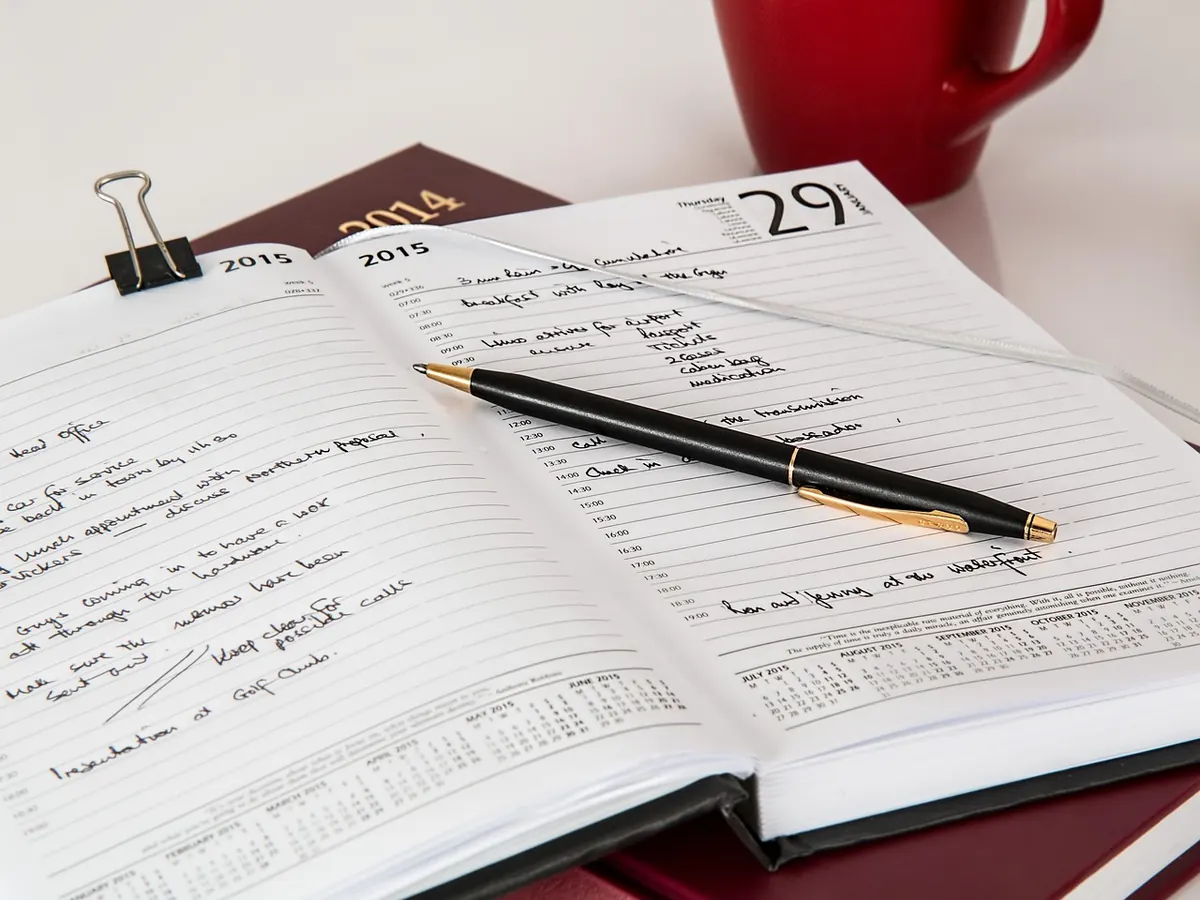
The first proper autumn morning usually arrives without warning. You leave the house in a jumper, the air smells of damp earth and woodsmoke, and the pavement is scattered with conkers nobody has bothered to pick up. By the time you get home, the light has changed again. Autumn moves quickly here — a few weeks of colour and cold snaps, then it's dark by half four — which is exactly why it's worth writing down.
Seasonal journalling isn't about producing beautiful prose. It's about noticing things while they're happening and keeping a record you can read back in February, or in ten years, when you've half-forgotten what October felt like.
Start with light and weather, not feelings
The quickest way in is to describe conditions rather than moods. Feelings are slippery and often the same as yesterday's; weather is specific and changes by the hour. Begin each entry with the date, the time, where you are and one thing you can see. That's it. You can add the rest afterwards, or not at all.
A short example, the kind of thing that works better than three paragraphs of reflection:
Tuesday 8 October, 7.40am, the rec. Low sun straight down the avenue of limes, mist sitting in the dip by the brook. First morning I've needed gloves. Two dog walkers, neither of them speaking.
Notice how much of the season is in there: the angle of the sun, the mist, the temperature, the quiet. None of it required you to feel anything in particular.
Prompts for an autumn walk
If you walk the same route regularly, you already have the best material available — a fixed point against which change becomes visible. Take one or two of these with you, either in your head or written on the first page of your notebook.
- What has changed since the last time you walked this way? Be literal: the hedge, the field, the tree by the gate.
- What's underfoot — acorns, beech mast, sycamore keys, wet leaves, a single lost glove?
- What can you hear that you wouldn't hear in July? Geese overhead, a Saturday match, leaves dragged along the path, or nothing at all.
- Who else is out, and what are they doing? The couple arguing quietly by the pond counts.
- Where is the light coming from, and what does it catch? Low sun turns ordinary things gold for about twenty minutes.
- What does the air smell of? Wet bark, cut grass, someone's chimney, the inside of a coat that's been in a cupboard since March.
- What did you bring home — a conker, a feather, muddy boots, or just cold hands?
If you've only got ten minutes
Pick one prompt, write three lines, and stop. A voice note recorded on the walk and typed up later in the week works just as well, and it often catches more detail than you'd manage sitting down. The point is the record, not the ritual.
Keep a running weather line
One line at the top of each entry, kept in the same order every time, builds into something quietly useful. Try: temperature, sky, wind, ground. Nine degrees, flat grey, wind from the east, leaves moving in gusts along the kerb. After a month you have a portrait of the season rather than a series of separate days.
Mark the small firsts as they arrive. The first morning you need the car lights on the way home. The first frost on the windscreen. The first day the clocks have gone back and the kitchen is dark at teatime. The first time you dig out the thick coat. Dated markers like these make your journal read like a calendar, and if you keep it up across a few years you'll start to see how much the timing shifts.
Traditions: write the small details
Autumn in the UK comes with a set of fixtures — half term, Halloween, Bonfire Night, apple days and harvest suppers, Remembrance Sunday, the first Christmas adverts appearing far too early. It's tempting to write these up as a summary: what you did, who was there, whether it was nice. Resist that. The memorable parts are almost always smaller and stranger.
Write the smell of the bonfire still in your coat the next morning. Write the exact words your dad used about the fireworks being smaller than he remembered. Write the child who refused to go anywhere near the sparklers and the one who wouldn't let go of them. Write what you ate, standing up, with cold fingers, and who you stood next to. If someone said something funny, put it in quotation marks and leave it alone. Dialogue ages extraordinarily well.
A few tradition prompts
- What did it smell like, at the moment you arrived?
- What did someone say that you'd like to remember exactly?
- What went slightly wrong? That's usually the part you'll retell.
- What did you wear, and was it enough?
- What will be different about this time next year?
Three-line days for when you're tired
The darker evenings do for many journals what January does for gym memberships. Rather than abandon the habit, lower it. Three lines is a complete entry: something seen, something heard or said, something that has changed. Or the simplest version of all — weather, small event, one thing you don't want to forget.
Gaps are fine. If you miss a fortnight, write the date you come back to and carry on without apology. A journal is not being marked, and no one is checking the streak.
Making it stick
- Choose a notebook you'll actually carry — small, cheap, and unbothered by rain.
- Put it somewhere you trip over it: the coat pocket, the kitchen table, the car door.
- Fix one weekly anchor rather than a daily target. Sunday evening, or straight after the Saturday walk, suits most people better than a vague daily intention.
- Start every entry the same way: date, time, place, weather. The repetition removes the blank-page problem.
- Keep two or three pages at the back for found things — a leaf pressed between the pages, a ticket, a conker, the label from a jar of apple chutney.
- Decide in advance that three lines counts as a proper entry, so a bad week doesn't end the whole thing.
Read it back in December, or on a wet afternoon in March. You'll be surprised by what you'd forgotten: the exact week the leaves came down, the temperature on the night of the fireworks, the way the mornings felt in that particular year. That's the reward — one autumn kept properly, in your own handwriting.
If the shorter days affect your mood more heavily than a bit of winter gloom, it's worth speaking to your GP rather than trying to journal your way through it. The page is a good place to notice how you're doing; it isn't a substitute for proper help when you need it.
Photo: neelam279 / Pixabay