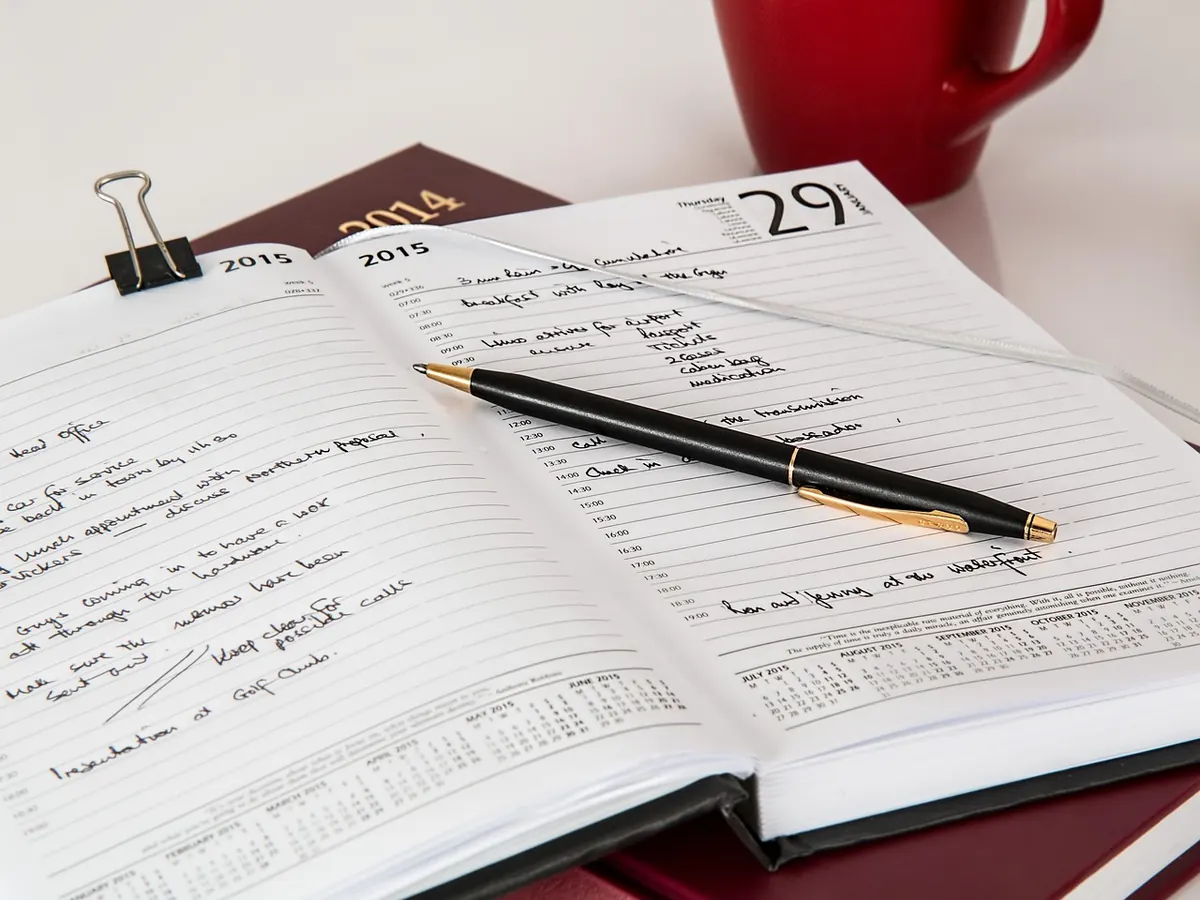
The rain starts at about ten and doesn't really stop. The heating ticks, the kettle goes on again, and the day narrows down to the room you're sitting in. That isn't a wasted day. It's a good one for a notebook.
The prompts below are written for exactly this sort of weather — the grey, drizzly, can't-face-the-bus kind. None of them need you to have had an interesting week. They are simply ways in. Choose one, set a timer for ten minutes, and start writing. If a prompt doesn't fit your mood, skip it. There are twenty-five others.
Why rain makes a good writing day
Sunshine asks something of you. There's a quiet pressure on a bright Saturday to be out somewhere, doing something worth reporting back on. Rain removes that pressure entirely. There is nowhere to be, nothing to miss, and no guilt about staying put.
Wet weather also sharpens the senses, which is useful when you're trying to fill a page. You notice the sound on the window, the smell of wet coats in a hallway, the particular grey light that makes a lamp necessary at two in the afternoon. Write those details down and you've already got a paragraph you'll be glad to reread in February.
There's another benefit. Rain links to memory more strongly than most weather. Most people can recall a school coat, a walk home with wet socks, a holiday that rained for four days straight. A prompt about weather is often really a prompt about being nine years old.
Before you open the notebook
Five minutes of preparation makes the writing easier, especially if you're the sort of person who finds reasons to get up again after two sentences.
- A mug of something hot within reach, and a second one planned.
- A lamp rather than the overhead light. Rainy afternoons are dim, and dim rooms make tired writing.
- Your phone in another room. Not face down on the table — another room.
- A pen you actually enjoy holding. If it scratches or skips, you'll stop sooner than you meant to.
- A timer. Ten minutes is plenty to start. Twenty is generous.
One more thing: don't write at the desk where you work if you can avoid it. A kitchen table, the end of the sofa, even a chair pulled up to the bedroom window will do. The change of position tells your brain this is the comfortable kind of thinking, not the deadline kind.
The 25 prompts
Work through them in order, dip in at random, or read until one makes you argue back. That last reaction is usually the sign you've found the right one.
Start with what's in the room
- Describe the exact sound the rain is making right now, and what it reminds you of.
- Name five small comforts within arm's reach, and say where each one came from.
- Describe the window you can see from where you're sitting — the glass, the frame, what's beyond it.
- What did you eat or drink today that tasted better because of the weather?
- Plan your ideal rainy afternoon hour by hour, from one o'clock until six.
Memory, home and the people in it
- Choose a house you've lived in and describe a single corner of it in detail.
- What did rainy days look like when you were a child? Follow one of them from morning to bedtime.
- Write about a coat, jumper or pair of boots you have loved and eventually worn out.
- Who taught you to make or mend something? Describe the process as they did it.
- Write about a meal that means home to you, and the first time you ate it.
Slowing down and looking honestly
- What have you been putting off that isn't urgent but does matter?
- Write a short letter to yourself in five years, dated today, mentioning the weather.
- What would you do with a completely empty Saturday, with no one to please but yourself?
- Name three things you're quietly proud of this month. Don't edit them down.
- What does rest look like for you when nobody is watching?
Weather, mood and the dark afternoons
- If today's weather were a mood, what would it be called, and where do you feel it in your body?
- Write about a time you got properly caught in the rain, from the first drop to the front door.
- How do the early dark evenings change the shape of your day? What would you keep, and what would you change?
- Write about an ending you're glad happened, even if it didn't feel like it at the time.
- Describe the last time the weather made you change your plans, and what you did instead.
Light relief
- Invent a neighbour who only ever appears when it rains. Give them a name and a habit.
- Write this week's forecast for your own life, in the style of the shipping forecast.
- List ten sounds you'd put on a rainy-day playlist that aren't music.
- Design a rainy-day café menu that only you would run. Describe the room as well as the food.
- Write tomorrow as though you already know it went well.
If you get stuck on the first line
The blank page is rarely about having nothing to say. It's usually about trying to say it well straight away. Borrow this trick: write the prompt at the top of the page as a heading, then answer it in the plainest sentence you can manage.
It's raining and I'm sitting in the kitchen with a mug that's gone cold. I'm going to write about the house on Peel Street.
That's enough. Nobody is grading the opening. A few other things that help:
- Keep the timer running. When it goes off, you're allowed to stop mid-sentence. Stopping while you still have something to say makes it far easier to return tomorrow.
- Follow the tangent. If a prompt about wet walks turns into a memory about your grandmother's kitchen, go with it. The prompt was only a door.
- Use "and then" when you stall. It sounds silly, but it forces the next sentence out and the writing usually loosens up after a line or two.
- Don't reread and correct. Editing belongs to a different day. Today is for filling the page.
Keeping it going after the rain stops
A wet afternoon is a good place to start, but the habit will only stick if it doesn't depend on the weather. Keep the notebook somewhere you already sit — beside the kettle, on the arm of the sofa, in the bag you take to work. One prompt a week is a real practice. One page is a real entry.
It also helps to lower the bar deliberately. Write badly on purpose sometimes. Write in bullet points. Write a list of what annoyed you and a list of what didn't. The point isn't a beautiful journal; it's a record of an ordinary life that will read as extraordinary in ten years' time.
Finally, a note worth making: if the dark afternoons and wet weeks leave you feeling persistently low rather than simply quiet, that's worth mentioning to your GP. Journaling is a good companion to proper support, not a replacement for it.
Fill the kettle, find a pen, and give one prompt ten minutes. That's the whole method.
Photo: lin2015 / Pixabay