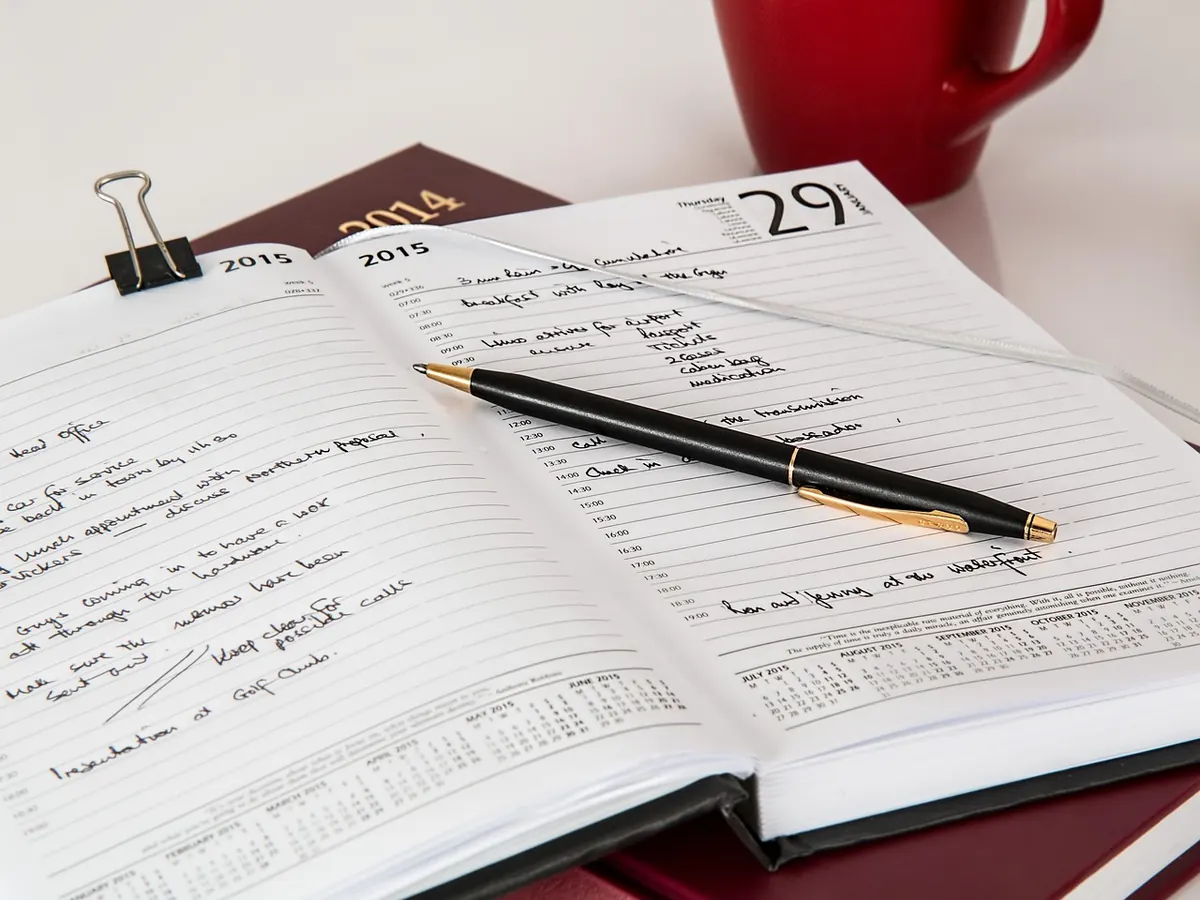
You are standing in a stationery shop with two notebooks in your hands. One has a date printed at the top of every page and a ribbon marker. The other is blank from cover to cover, waiting for whatever you bring to it. Both are sold as somewhere to write about your life, and the difference between them matters more than the cover suggests. Pick the wrong format and you will write for a fortnight, then quietly stop. Pick the right one and the habit tends to hold.
So here is what each format is genuinely good at, where each one trips people up, and how to choose without overthinking it.
What a dated diary does well
A dated diary — often sold as a page-a-day or one-line-a-day book — gives you a fixed slot for every day of the year. That structure is the whole point. You do not have to decide whether today deserves an entry, because the page is already there, with today's date on it. The decision has been made for you.
This suits short, concrete records: the weather, what you ate, who you saw, how you slept, one moment worth keeping. Over a year you build a trail you can flick back through. If you are tracking a habit, noting symptoms for a later GP appointment, or simply want to remember what an ordinary Tuesday felt like, a dated diary is hard to beat. Keep factual notes rather than diagnoses, and for anything health-related, speak to your GP rather than relying on your own records alone.
The weakness is equally clear. Miss a week and you have a week of blank pages staring at you. Some people find that motivating; many find it quietly shaming, and the notebook gets abandoned somewhere around March.
What a journal gives you instead
A journal is undated. There is no page assigned to today, no implied quota, and no visible gap when you skip a fortnight because work was busy or you simply did not feel like it. You date each entry yourself, or you do not.
What you gain is room. A journal is better for thinking on paper: working through a decision, untangling a mood, writing a long account of something that mattered, making lists, sketching, copying out a passage you want to remember. One entry might run to three pages; the next might be a single line. That flexibility is the appeal.
What you lose is momentum. A blank page asks you to supply both the occasion and the energy, and on a tired evening that is a lot to ask. Undated notebooks also drift: without dates at the top of each entry, it becomes difficult to see how your thinking has changed.
The practical differences, side by side
- Structure: a diary decides when you write; a journal leaves that entirely to you.
- Entry length: dated pages nudge you towards a few lines; a journal can hold three pages or three words.
- Missed days: a diary displays them; a journal hides them.
- Deep reflection: journals handle it better. Diaries are strongest for snapshots.
- Prompting: a diary prompts you daily. A journal needs a trigger you create, such as writing with your first coffee.
- Looking back: dated pages make anniversaries and patterns easy to find. In a journal, date every entry or keep a simple index at the back.
- Longevity: an undated notebook never expires. A dated one becomes awkward to use once the year runs out.
Which format suits your reason for writing?
If you want to remember your days
Choose a dated diary. The point is the record, not the prose. A few lines each evening, kept for years, becomes something genuinely valuable to read back.
If you want to understand your own thinking
Choose a journal. Long entries need space that a dated page will not give you, and the freedom to write twice in one day or not at all for a week is worth more than a neat sequence of dates.
If you are trying to build a habit
Start with a dated diary, because the printed date is a daily nudge. If you find yourself resenting the small space, move to a journal and set your own cue — same chair, same time, same pen.
You do not have to choose one
Plenty of people end up with a hybrid, and it works well:
- One line a day in a dated diary, plus a journal for the longer entries when something needs more room.
- A single undated notebook, with the date written at the top of every entry.
- A weekly rhythm: daily fragments in a planner, then a proper journal page each Sunday reviewing the week.
- A diary for a specific stretch — a trip, a house move, a new baby — and a journal for everything else.
Before you buy either, ask yourself: what do I want to still know about this week in five years?
Your answer usually points at the right format. If it is facts and moments, take the dated diary. If it is thoughts and reasons, take the journal.
How to decide in ten minutes
- Finish this sentence in one line: "I want to write because…" Be honest. Memory, relief, habit, or curiosity all lead to different notebooks.
- Think about the last thing you wrote for yourself. Was it a few words in your phone, or a page in a notebook? Match the format to your natural length.
- Buy something cheap first. A dated diary with a flimsy cover and an inexpensive blank notebook will both tell you more in three weeks than a month of deliberation.
- Check the practicalities: does it lie flat, does your pen bleed through, is it small enough to carry or big enough to write comfortably in?
- Decide where it lives and when you will write. Bedside table, ten minutes before lights out, is the simplest arrangement that survives a busy week.
- Judge it after a month, not after three days. Early wobbles are normal.
Getting started without guilt
Two minutes counts as an entry. A single sentence counts. If you miss a stretch, do not backfill — write today's date and carry on, because a diary is a record of what happened, not a debt you owe the paper. Never tear pages out; the messy weeks are part of the honest picture. Keep a pen with the notebook so nothing has to be hunted for, and read back over the last month for ten minutes at the end of it. That review is where most people discover what they actually needed to write about.
And if writing about difficult feelings leaves you more distressed rather than less, ease off and talk to someone. A notebook is a useful tool, but it is not treatment; your GP or a qualified counsellor is the right place for that conversation.
Photo: kaboompics / Pixabay